

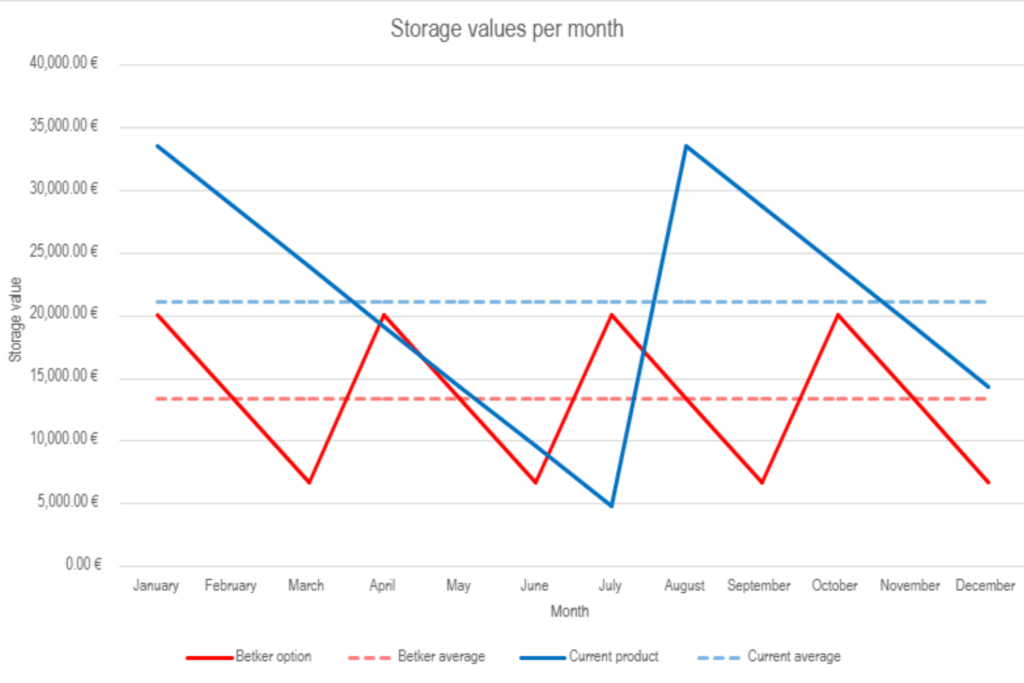
In many industrial processes, storage is an essential part of ensuring production continuity. At the same time, it ties up significant amounts of capital and resources. According to Betker’s Technical Support Engineer, Ville Lappi, efficient inventory management and optimised delivery cycles can lead to substantial savings — freeing up as much as 40 % of the capital tied up in stock for other uses.
“When we moved from a six-month delivery interval to a two-month cycle, the customer’s average inventory value decreased significantly. This was immediately visible as released capital and lower storage costs,” Lappi explains.
Freeing Up Inventory Capital Increases Production Flexibility
Inventory ties up money that the company cannot use elsewhere. In addition, large stock levels require space and maintenance, further increasing costs.
“If deliveries are made only a few times a year, large volumes must be stored at once. That means bigger storage areas and higher investment in warehousing. When the delivery frequency increases, inventories shrink, and so do maintenance and infrastructure costs,” Lappi says.
Betker’s model is based on close cooperation with the customer. The delivery rhythm and inventory needs are defined together, and the technical support team monitors the process performance on site to ensure smooth operation.
Total Value Matters, Not Just the Unit Price
Betker’s approach differs from the traditional price-driven model. Lappi emphasises that real value comes from the overall service, not from the price of an individual product.
“We rarely enter projects with a price-first mindset. Our mission is to develop the customer’s processes and support them from start to finish. Our support doesn’t end with delivery — we’re often on-site during testing and help with further development,” Lappi explains.
This customer-orientated approach also shows in inventory optimisation. When Betker fully understands the customer’s process, deliveries can be planned more proactively and flexibly.
Towards an Automated Supply Chain
Lappi sees the next development step in deepening customer integration into the supply chain. The goal is for Betker to receive real-time data on customer maintenance and installation schedules.
“If we know exactly when an installation is coming up, we can deliver the products just days before. This minimises the need for storage and keeps capital free for other use,” Lappi says.
Such a model benefits both sides: the customer’s processes remain flexible and cost-efficient, while Betker can respond quickly to changing needs.
Continuous Improvement for the Customer’s Benefit
Inventory optimisation is just one example of how Betker’s technical support helps customers develop their processes holistically.
“Our goal is to create added value for the customer on all levels: technical, financial, and operational,” Lappi concludes.
The result is more efficient production, less tied-up capital, and a stronger competitive edge. Better with Betker.
Interested in learning how to reduce inventory capital in your production?