“Watch your mouth” is a phrase that many of us have heard. This also applies to melting furnaces – the mouth area is an important part of the system, and its service life is a challenge for many foundries. Mouth elements made of standard furnace lining compound are particularly problematic because the iron scrap fed into the furnace subjects them to high wear. This, in turn, often leads to premature maintenance downtime, additional costs and lost production time.
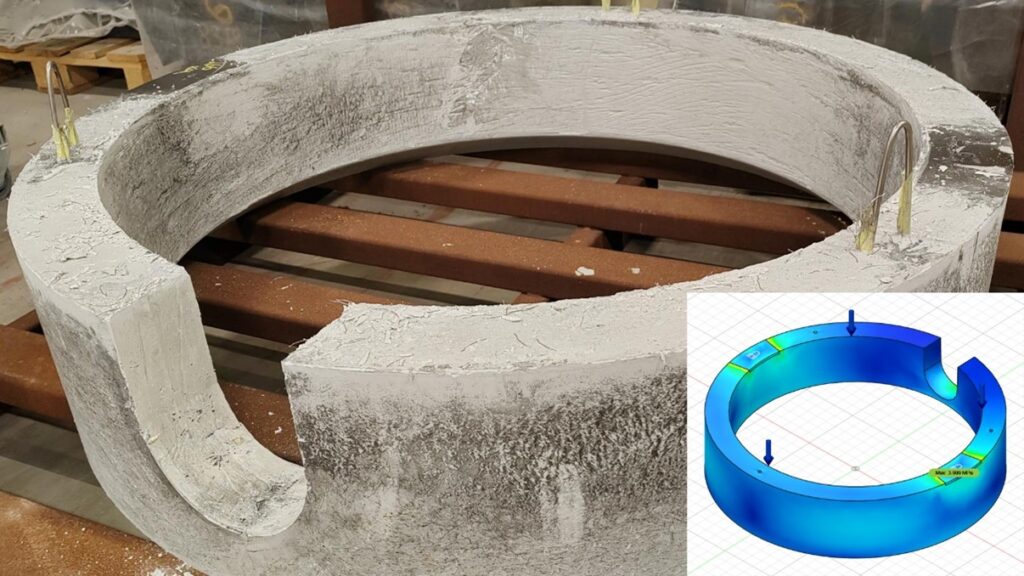
To solve the problem, we have developed a new mouth element for the foundry environment. The element’s design and materials can be customised according to each customer’s needs, and it is designed to withstand high temperatures and mechanical stress.
Development process
We developed the first mouth element for one of our foundry customers last autumn. The process started with a thorough mapping of the customer’s needs and an analysis of the current challenges. In this case, too, the biggest problem proved to be the wear of the furnace mouth area due to the feeding of scrap.
Once the main issue was known, we designed a preliminary CAD element with rough dimensions. We worked closely with the customer throughout the design process to ensure that every detail was taken into account. Such details related to the mouth ring included the need for a slag discharge opening, the shape of the furnace nose and the mouth element’s fastening method. In addition, the position of the element lifting eyes must also be taken into account to ensure smooth installation.
Once the CAD model was completed, we carried out a FEM (Finite Element Method) review. In this review, we assess the overall strength of the element and adjust the structure based on the results, if necessary. The same method is also applied to the fastening solution. These calculations also help us ensure that the new mouth element lasts as long as possible.
Implementation
Once the design of the element was fine-tuned, we began the implementation. Thanks to the pre-prepared drawings, the mould design took only a few days. We chose the Tangle solution as the material. Containing approximately 30% steel fibres and a high-aluminium oxide mass, this material is commonly used in high-wear areas. The steel fibres contribute to a particularly high wear resistance, as the micro cracks created in the pulp during the scrap feeding stop at the fibre interface instead of breaking the element prematurely.
After selecting the material and fabricating the mould, we proceeded to casting, which went flawlessly. The entire process from needs assessment to sending the element to the customer took less than 3 months!
If you have encountered similar challenges in your production and would like to extend the maintenance interval of your furnace, please contact us – at Betker we are happy to help!