
Is it possible to extend the lifecycle of a lance used in steelmaking while simultaneously reducing costs, improving logistics, and minimising material waste?
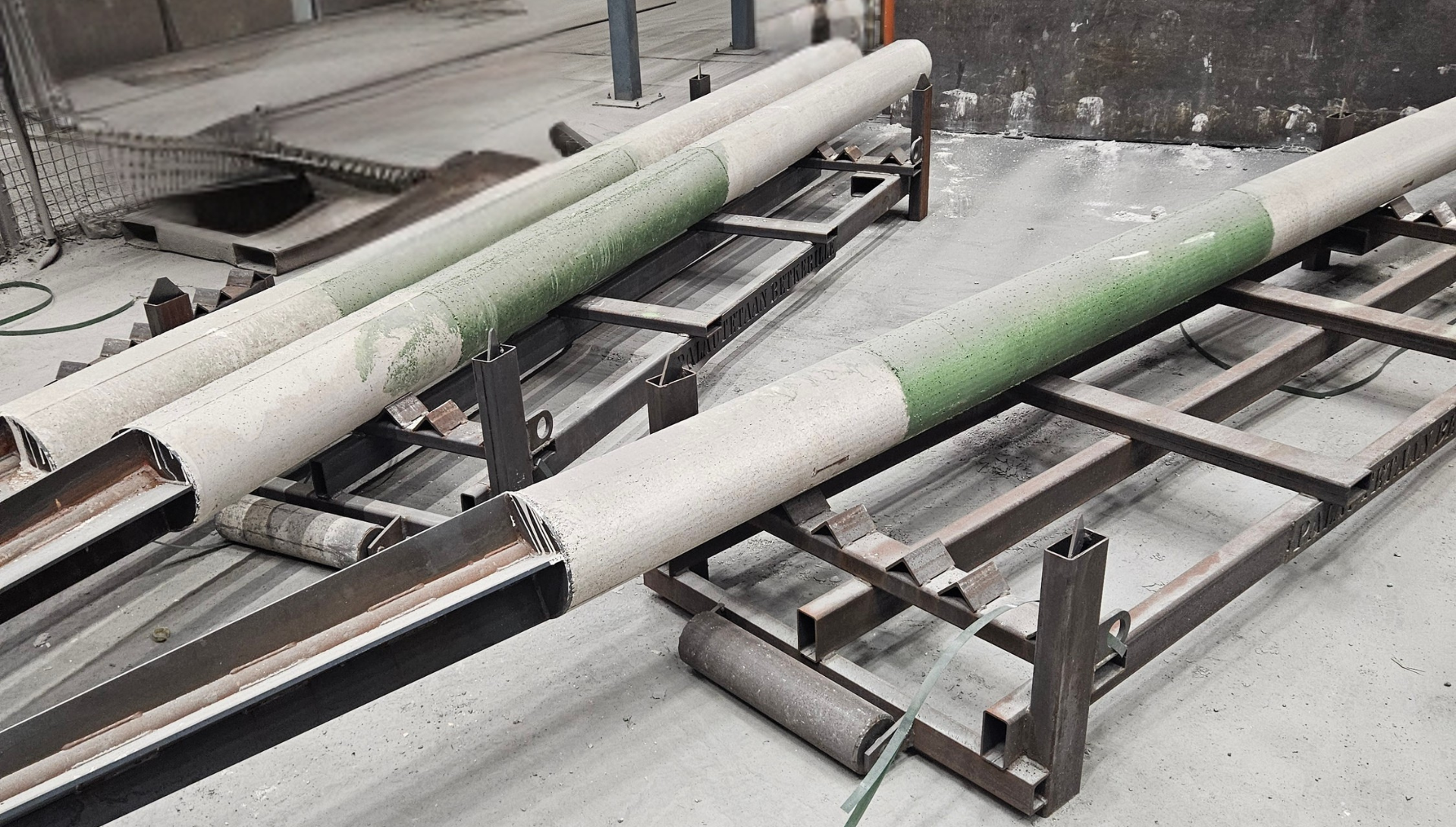
At Betker, we are currently developing a new lance solution in which the upper section of an injection lance is reused across multiple operating cycles. The solution is designed for ladle treatment in steelmaking, where the chemical composition and temperature of molten steel are adjusted.
What Changes Compared to a Conventional Lance Solution?
Traditionally, a lance is removed from service in its entirety once its refractory lining is worn out. In practice, this means that both the refractory part and the metallic support structure of the lance are scrapped, even though the upper section may still be fully usable.
In the new solution, the lance is divided into two parts:
- a consumable lower section containing the refractory lining
- a reusable upper section that remains intact and is transferred to the next lance
“Wear often affects only one part of the structure, yet the entire lance is taken out of service. That’s where we saw development potential,” says Antti-Eemeli Satokangas, Technical Support Engineer at Betker.
Typically, the service life of a lance is measured in days or weeks. The aim is for the upper section to remain in circulation for up to a year.
High Requirements: Temperature, Safety, and Usability
Conditions in steel treatment are extreme. The temperature and quality requirements of molten steel impose strict demands on refractory materials.
The structure must withstand lifting and handling without risk of failure. The joint must be safe and reliable to ensure that the lance does not detach or fall. At the same time, the solution must be user-friendly: the joint needs to be easy to dismantle and assemble so that daily operations do not become more complicated.
As the upper section is transferred from one lance to another, its structural requirements are higher than those of a single-use design. In practice, this requires careful engineering and thoroughly tested joint solutions.
Development in Close Cooperation with the Customer
In this type of development work, Betker’s Technical Support Engineer acts as the practical project leader. The work takes place at the interface between the customer and Betker’s own organisation, involving the gathering of data, the exchange of ideas, the evaluation of technical alternatives, and the advancement of the overall solution. The joint design has been assessed from both safety and installation perspectives.
The development process includes structural design, coordination with machine shops, scheduling, and technical approval. Although it is not formally structured as a project organisation, responsibility for progress, communication, and technical performance lies with the technical support function.
The goal is a solution that is both technically sound and economically viable.
Benefits Across the Entire Value Chain
When the lance length is reduced and part of the structure remains in circulation, the effects extend beyond a single component. The impact can be seen in material costs, storage, production efficiency, and logistics.
In Betker’s production, a shorter structure simplifies handling and frees up storage space. In transport, more products can be loaded into a single shipment, reducing delivery costs.
From the customer’s perspective, the solution introduces one new work phase: assembling the lance. Ultimately, overall profitability depends on the balance between the savings achieved and the additional work required.
The next step is to test the technical functionality of the solution in practice. After testing, profitability calculations will be completed and a decision will be made regarding potential wider implementation.
A Small Structural Change — A Significant Shift in Thinking
In steelmaking, refractory solutions are often critical yet inconspicuous parts of the overall process. In this development work, attention is focused on a component traditionally regarded as single-use.
By separating the reusable part from the consumable section, there is potential for significant savings — both financially and in terms of material use.
The test results will determine the final direction. One thing, however, is already clear: the principles of the circular economy are reaching ever deeper into high-temperature processes.
And in that development, Betker intends to play an active role.
Would a Similar Approach Work in Your Process?
If lance usage, material costs, or logistics raise questions in your operations, let’s discuss them. Together, we will review your process and identify where the greatest lifecycle optimisation potential lies.
Contact Betker’s technical support, and let’s build a solution that performs both in operation and on the balance sheet.