As with all our operations, we always strive to make use of refractory materials as efficiently as possible. The goals vary from site to site, but they are primarily related to maximising the product’s service life and minimising maintenance downtime. These two things were our main goals when we began to develop our tundish safety lining practices to be more efficient than the traditional casting process. The result of this extensive development work was our completely new solution: tundish safety lining elements, which we are currently testing in the production of one of our customers.
The tundish safety lining is almost always subjected to significant mechanical stress and stress caused by temperature fluctuations. The typical service life of linings varies from site to site, but generally the length of a lining campaign varies between a few hundred and a couple of thousand melts for casting. This means that the lining is in use for several months, often even more than a year. The safety lining is typically protected by a so-called wear lining, which is renewed after each casting – this enables a long service life of the safety lining. However, despite the protective effect of the wear lining, the safety lining wears down over time.
The main cause of wear is the removal of the wear lining from the tundish by tipping it over. The steel and slag solidified to the bottom of the tundish in casting are removed by turning it upside down, so that the residual material is released from the tundish along with the wear lining. When the tundish is tipped, this solidified material tends to “tear” off of the other wall of the tundish as it falls under the force of gravity. This phenomenon causes wear especially to the middle of the safety lining. A secondary but at least equally significant cause of wear is the wear lining burning onto the safety lining. This occurs when the wear lining is too thin, and it will not come off of the tundish using gravity. When this happens, the wear lining has to be broken away from the safety lining, which wears down the safety lining considerably.
Since it is very unlikely that the safety lining can be successfully repaired by casting or plastering, we wanted to develop a completely new lining solution carried out using elements. The special advantage of elements is their strength and ability to be quickly replaced compared to traditional casting compounds – our goal is that, if necessary, the elements from worn areas of the tundish can be replaced with new ones without the need to renew the entire lining by casting. Partial repair speeds up the maintenance of the tundish and saves significant costs, for example, by reducing the consumption of safety lining material.
However, even greater savings are achieved through the wear lining material; as the safety lining wears down, the consumption of wear lining also increases, as it must fill all the voids and cracks created in the safety lining. In a worn tundish, the consumption of wear lining material may increase by dozens of percent compared to a tundish with a new safety lining. By keeping the safety lining in good condition through the regular replacement of worn elements, the formation of voids and cracks in the safety lining is prevented and the consumption of the wear lining material is significantly reduced. The savings potential is therefore considerable.
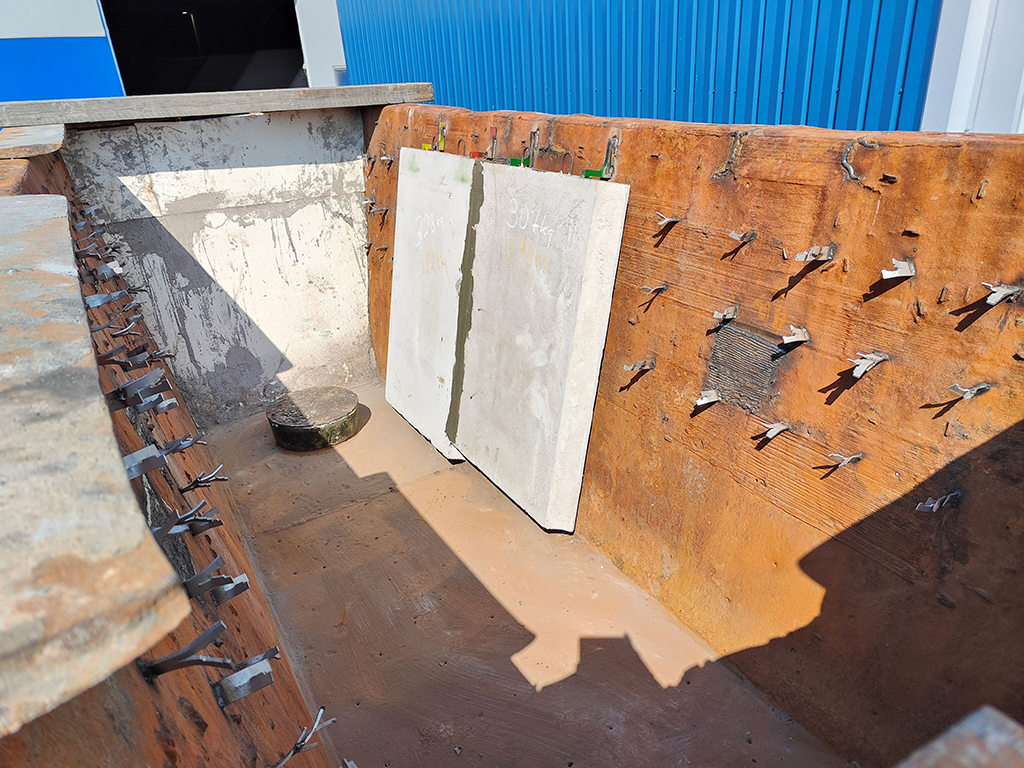
We are testing the new element practice in the tundish of one of our customers, where we installed two separate safety lining elements. The rest of the lining was made with the traditional casting compound to make the differences in wear more visible. The elements are installed in the middle area of the tundish that is subject to the greatest wear. Our goal is that, in the future, the tundish could be completely lined with elements – in which case all parts of the tundish from the bottom to the walls could be easily partially repaired if necessary.
If this topic sparked your interest, please contact us – we will help you create a suitable element solution for all tundish types!